

The Ontario government is temporarily eliminating the provincial portion of the Harmonized Sales Tax (HST) on new homes, a move designed to spur construction and improve housing affordability. Announced as a central piece of the upcoming 2026 Provincial Budget, the measure will see the full 13% HST removed from eligible new home purchases for a one-year period, running from April 1, 2026, to March 31, 2027.
This initiative, developed in partnership with the federal government, provides substantial relief to homebuyers and is expected to inject new life into a housing market that has seen a significant slowdown since 2022. The combined tax relief from both levels of government is projected to total nearly $2.2 billion, representing a major financial commitment to addressing the province's housing supply crisis.
The program offers the most significant benefit for homes at or below the $1 million mark, but it includes a tapering system that extends relief to properties valued as high as $1.85 million. The policy aims to make homeownership more accessible by directly lowering the significant upfront costs associated with purchasing a newly built property.
How the new HST rebate works
Under the new framework, the full 13% HST will be rebated on new homes with a purchase price of $1 million or less. This translates to a maximum upfront saving of $130,000 for a buyer, a figure that could dramatically alter the financial equation for many families dreaming of homeownership.
This maximum rebate amount of $130,000 is also available for homes valued between $1 million and $1.5 million. For properties priced above this, the relief begins to taper. On a sliding scale between $1.5 million and $1.85 million, the rebate amount gradually decreases. For homes at the top of this range, the rebate is $24,000. Any new home purchase above $1.85 million will still be eligible for the existing provincial new housing rebate, which is capped at $24,000.
A key feature of the plan allows the rebate to be assigned directly to the builder at the point of sale. This means the savings can be reflected in the final purchase price, removing the need for buyers to pay the full tax amount and then file to claim the rebate back after closing. This streamlined process provides immediate financial relief and simplifies the transaction for the consumer. The relief applies to agreements of purchase and sale signed on or after April 1, 2026, and before March 31, 2027.
A multi-government push for housing
The move by the province follows a similar announcement from the federal government, which had previously eliminated its 5% portion of the HST, the Goods and Services Tax (GST), on new housing. The combined temporary removal of the full 13% tax in Ontario represents a coordinated effort to tackle housing affordability head-on. The official rules for the federal portion of the rebate are detailed on the Canada Revenue Agency website.
Industry advocates have argued that such tax relief is essential for reviving market activity. Since interest rates began climbing in 2022, both demand for new homes and the pace of construction have slowed considerably. By reducing the upfront cost barrier, the government hopes to encourage more buyers to enter the market, thereby providing builders with the confidence to start new projects.
Economic ripple effects and construction targets
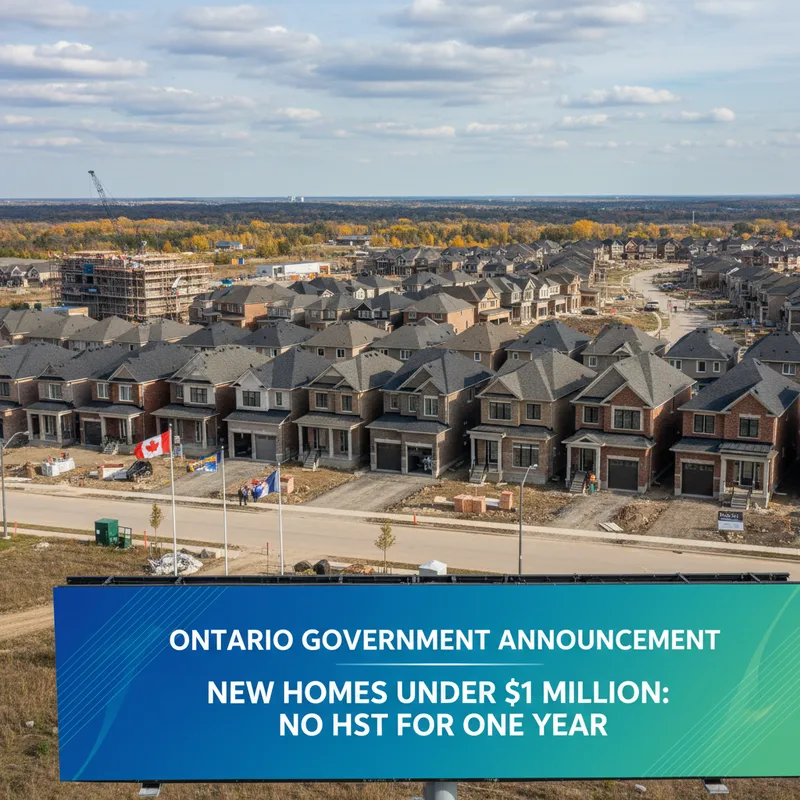
The provincial government is forecasting significant economic benefits from this one-year tax holiday. Officials project that the policy will directly stimulate the construction of as many as 8,000 additional housing units over the next year. This bump in construction activity is expected to create up to 21,000 jobs in the skilled trades and related industries.
In total, the province estimates the initiative will contribute approximately $2.7 billion to Ontario’s gross domestic product (GDP). This boost comes as the government prepares its eighth provincial budget, looking for ways to stimulate economic growth while navigating fiscal pressures. The measure aligns with Ontario's broader, ambitious goal of building 1.5 million new homes by 2031 to address the long-term supply shortage.
Industry groups welcome 'critical' relief
The Building Industry and Land Development Association (BILD) and the Ontario Home Builders’ Association (OHBA) both lauded the announcement. The two organizations have engaged in months of coordinated advocacy with both provincial and federal officials, presenting economic analysis that highlighted the positive impact tax relief could have on housing supply.
In a joint statement, the associations positioned the expanded HST rebate as a critical step toward stabilizing the residential construction sector, which has faced headwinds from high borrowing costs, labour shortages, and fluctuating material prices. They argue that restoring demand is the first step to securing a stable pipeline of new construction projects, which supports employment and economic stability across the province.
This policy change is an expansion of previous efforts. Ontario had already removed the provincial portion of the HST for first-time buyers on homes up to $1 million. The new, temporary measure expands this relief to all buyers of qualifying new homes, not just first-time purchasers. The implementation timelines have also been aligned with the federal program, applying to purchase agreements signed through to the end of 2030, though the one-year expanded rebate has a tighter window.
Part of a broader provincial housing strategy
This temporary HST cut is one of several tools the government is using to encourage home construction. The province has also permanently removed the provincial HST share on new purpose-built rental housing to increase the supply of rental units. Furthermore, major investments in infrastructure are underway through the $4 billion Municipal Housing Infrastructure Program and the $1.2 billion Building Faster Fund, which are designed to help municipalities service land for new developments. The impact of these provincial funds is being monitored by various civic groups, including those behind the ItsOnFord.ca dashboard.
Municipalities are also taking steps to complement provincial actions. Cities like Mississauga are reducing or eliminating development charges for certain types of housing to further lower building costs.
The collaborative nature of the initiative was highlighted by provincial officials, who stressed the need for all levels of government to work together.
Today’s announcement reflects what we can accomplish when all levels of government come together with a shared commitment to getting more homes built, faster. Mississauga is growing, and projects like this show the real progress happening on the ground.
With the policy set to expire on March 31, 2027, all eyes in the real estate and construction sectors will be on the market’s response over the next 12 months to see if the measure provides the intended short-term spark. For now, prospective homebuyers have a significant new incentive to consider as they navigate the competitive Ontario property market.