

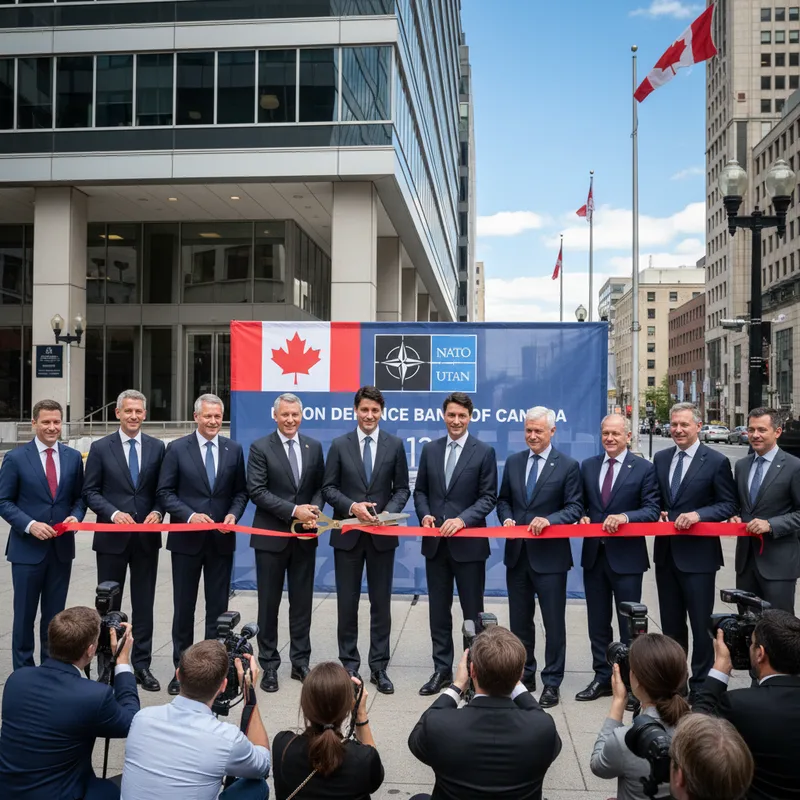
Canada has been chosen as the headquarters for a new NATO-led financial institution, the Defense, Security and Resilience Bank (DSRB), a senior government official confirmed Wednesday.
The decision was made following a series of negotiations hosted by Canada, which involved nearly 20 founding members of the proposed bank. The institution is designed to pool the credit strength of NATO members and partner countries, thereby reducing borrowing costs for military and security-related spending.
The primary aim of the DSRB is to make it more affordable for nations to meet their collective defence spending commitments. By leveraging the stronger credit ratings of some members, the bank can secure more favourable lending terms on the international market, which can then be extended to all participants for defence investments.
The announcement comes as Western nations continue to adapt to a changed global security landscape, largely prompted by Russia's full-scale invasion of Ukraine in 2022. That conflict spurred many NATO countries to significantly increase their military budgets and invest in new equipment and ammunition. The DSRB represents a long-term strategy to sustain that heightened level of investment.
Toronto makes its bid
While the federal government has not yet named a host city, Ontario Premier Doug Ford has already begun lobbying for Toronto to be chosen. In a social media post, he argued that Canada's largest city is the ideal location for the new institution.
As our nation’s financial capital, with a skilled workforce and unparalleled global connectivity, there’s no better place for the bank to be headquartered than Toronto.
Ford said hosting the bank would be "an opportunity to put Canada at the center of global defense finance and manufacturing." Toronto is the heart of Canada's financial sector, home to the country's five largest banks, the Toronto Stock Exchange, and a sophisticated ecosystem of financial services firms. The city's proponents argue this existing infrastructure makes it a natural fit for a major international financial institution. Landing the DSRB would not only bring jobs and prestige but would also reinforce the city's standing as a key player on the world financial stage. Improving the financial knowledge of the next generation has also been a recent focus in the province, with a new financial literacy test for high school graduation.
Canada boosts its commitment
Housing the new defence bank aligns with the federal government's recent pledges to significantly increase its own military spending. Prime Minister Mark Carney’s government has committed to meeting NATO's long-standing defence spending guideline, which has been a point of contention with some allies.
NATO countries have a formal agreement to spend at least two per cent of their Gross Domestic Product (GDP) on defence. For years, Canada has faced criticism, particularly from the United States, for failing to meet this two per cent target. Former U.S. President Donald Trump frequently complained that Canada and other allies were not paying their fair share for collective security.
However, the current government has signalled a major policy shift. Prime Minister Carney stated last year that Canada would meet the two per cent target this year. He later made an even more ambitious pledge, committing the country to reaching five per cent of GDP on defence spending by 2035. This dramatic increase reflects a broader reassessment of Canada's role in a world facing renewed great power competition. Securing the DSRB headquarters could be seen as a strategic move to demonstrate leadership and commitment within the alliance beyond direct spending increases. It positions Canada as a key facilitator of the West’s collective defence and security architecture, leveraging its reputation for financial stability and multilateral cooperation. Details on how government funds are being utilized can also be seen in local investments, such as the Ontario government's plans for Toronto Island.
A new financial tool for a new era
The creation of the DSRB marks a significant evolution in how the NATO alliance approaches burden-sharing and capability development. For decades, the focus has been on direct spending targets, but this new bank provides a cooperative mechanism to achieve those goals more efficiently.
By helping countries finance major procurement projects, from new fighter jets to advanced naval vessels, the bank will aim to bolster the alliance's overall military readiness. It also provides a framework for coordinating industrial defence efforts, potentially leading to more joint-development projects and standardized equipment among member nations. This interoperability is a critical force multiplier in coalition operations.
The senior official who confirmed the news spoke on the condition of anonymity as they were not authorized to comment publicly before an official announcement. With the decision now made, the next step will be the formal establishment of the bank and the selection of its permanent home, a process that Canadian cities will be watching closely.