
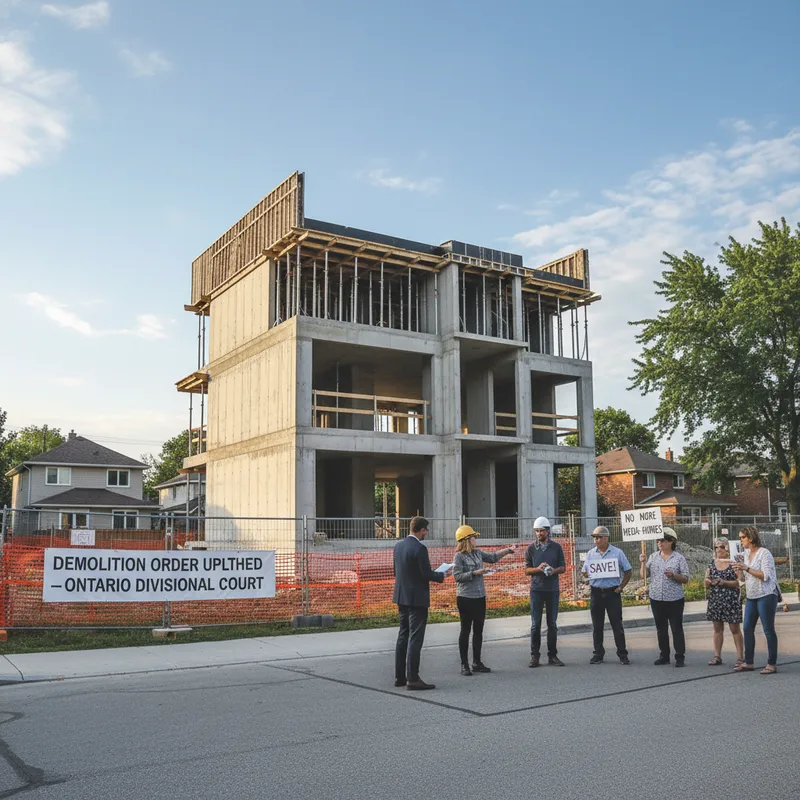
A Woodbridge-based developer has been ordered to tear down a partially constructed building in Ajax after a nearly five-year legal battle with the town over construction that began without the necessary permits. The decision marks a major victory for the municipality in a case that has highlighted the tension between development pressures and regulatory compliance.
On Thursday, the Ontario Divisional Court dismissed an appeal from First Avenue Properties, upholding a previous Superior Court of Justice ruling from September 2025 that ordered the demolition of the structure at 599 Kingston Road West. The site, located at the corner of Church Street in historic Pickering Village, has been an unfinished construction zone since late 2021.
Ajax Mayor Shaun Collier called the ruling a “significant victory” for the town and its residents, affirming the importance of adhering to municipal planning and development laws.
Long-running dispute began in 2021
The dispute traces back to 2015, when First Avenue Properties acquired the land, a former automotive repair and sales facility that required environmental remediation before any new construction could begin. The developer's plan, marketed on its website as ‘FiveNineNine,’ envisioned a modern, four-storey apartment building with 60 suites and ground-floor retail space.
For years, our town has stood firm. Since 2021, we have worked through every necessary process with First Avenue, the Ministry of the Environment, Conservation and Parks and the courts to hold this project accountable. This has not been a quick or easy fight, but we remained committed to defending the interests of our residents and protecting the integrity of our planning and development rules. Today’s decision sends a clear message: our community will not be ignored, and developments that bypass the law will not be tolerated in Ajax.
While the Town of Ajax granted conditional approval for the project in 2021, allowing for some preliminary work, it never issued a full building permit for the above-ground structure. According to court documents, a town building inspector visited the site on October 13, 2021, and discovered that construction had already proceeded on “above grade elements.”
The court heard that First Avenue had not only failed to secure a full permit but had also neglected to have the below-grade elements of the foundation inspected, a fact the company did not dispute. The town promptly issued an Order to Comply, demanding a halt to all unauthorized work. However, a subsequent visit on October 27 revealed the order had been ignored, with construction continuing on the upper levels. Core slabs for the second floor were installed without municipal authorization, a critical breach of building regulations.
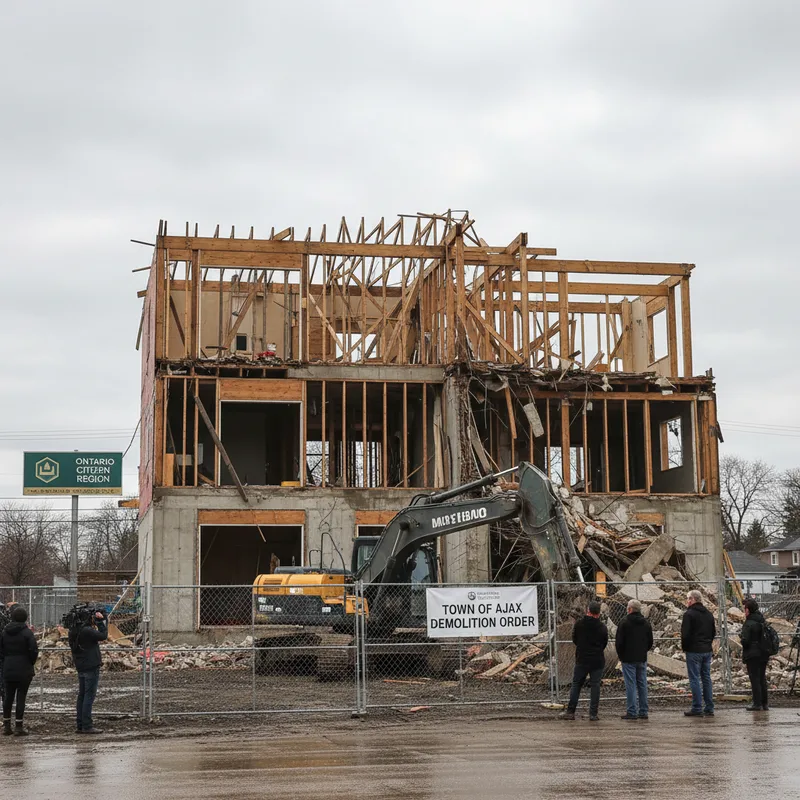
Developer made 'calculated decision' court rules
The partially built ground floor has sat untouched since November 2021, a visible symbol of the protracted legal fight. In court, First Avenue argued that a demolition order was an unfair penalty for circumstances it claimed were beyond its control. It proposed that a better solution would be to allow it to continue working towards the final building permit.
However, Justice Annette Casullo of the Superior Court of Justice firmly rejected this argument in her September ruling. “I could not disagree more,” she stated. “First Avenue finds itself in these circumstances solely of its own accord. It failed to comply with the terms it explicitly agreed to.”
Justice Casullo concluded that the developer made a “calculated decision” to proceed with construction without proper authorization or the required inspections. She noted that the company chose not to complete the necessary environmental remediation of the site, a key condition for the project's approval. “First Avenue’s conduct must not be rewarded,” Casullo wrote. “An order for demolition is the only just and appropriate remedy in the circumstances.” The Divisional Court’s decision this week solidifies that conclusion.
A message to developers
The case serves as a stark reminder of the authority of municipal governments to enforce their bylaws and building codes. In a province grappling with a severe housing shortage, governments at all levels are seeking ways to expedite construction, including the elimination of HST on new rental builds. This ruling, however, underscores that the push for speed cannot come at the cost of safety and regulatory integrity. The lack of inspections on the building’s foundation and structural elements raised significant safety concerns that were central to the court’s decision.
The outcome is also a victory for residents of Pickering Village, who have lived with the abandoned construction site for years. Such sites can often become eyesores and magnets for vandalism, affecting community morale and property values. The resolution of similar disputes over land use, such as the ongoing debate over event bans in Oshawa’s Memorial Park, often hinges on balancing development interests with community standards.
Legal disputes between property owners and governing bodies are not uncommon, with a recent case in New Zealand seeing apartment owners win a significant dispute over fees. However, an order for complete demolition is a drastic and relatively rare outcome, reserved for the most serious violations, which the Ontario courts found this to be.
With the legal challenges exhausted, the Town of Ajax has announced it will work with its legal counsel to take the “appropriate steps” to ensure the demolition order is carried out. First Avenue Developments has not responded to requests for comment on the court’s final decision.