

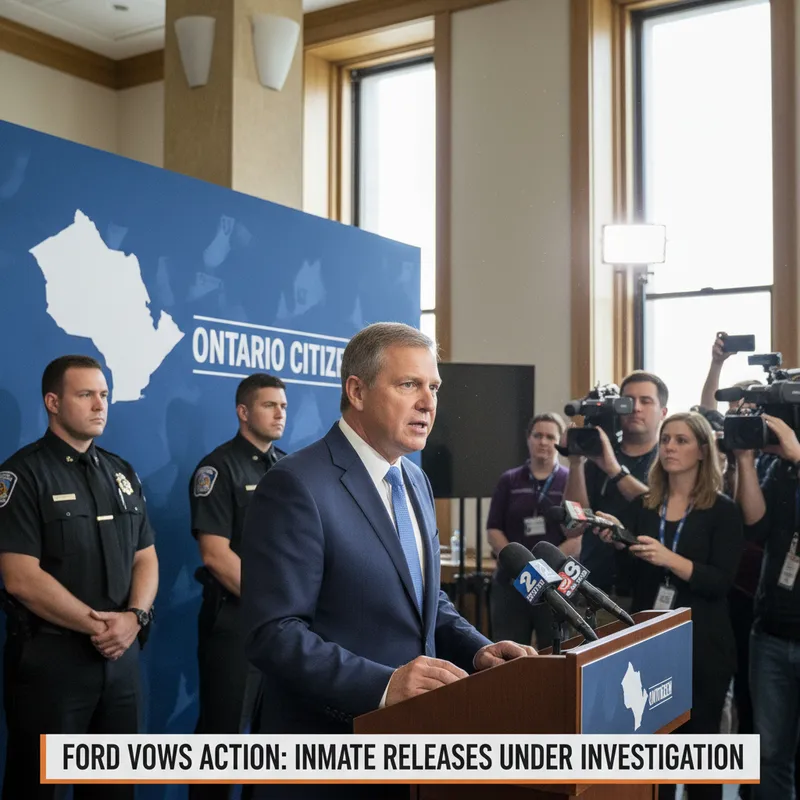
Premier Doug Ford has vowed to “get down to the bottom” of systemic failures that led to more than 150 inmates being improperly released from Ontario’s correctional facilities over the past four years. The admission comes after government documents, brought to light through freedom-of-information requests, revealed 157 inmates were mistakenly freed between 2021 and 2025.
The errors, which ranged from administrative mix-ups to human error within both the jails and the court system, have raised serious questions about the stability and capacity of the province's corrections system. Speaking on Wednesday, Ford did not mince words about the findings.
The premier’s tough stance was mirrored by Solicitor General Michael Kerzner, who received briefing notes on the issue last year. Despite the advance warning, Kerzner did not specify what actions have been taken since he was made aware of the problem. “I am going to make sure that we understand exactly what happened,” Kerzner said, adding, “You have to remember something, that we have many, many people moving in and out of our correctional system every day.”
Liberals criticize government inaction
The revelations prompted a heated exchange during Question Period at Queen’s Park, where the provincial Liberals repeatedly pressed the Ford government for answers. Interim Liberal Leader John Fraser said his party raised the issue 11 times but received no direct acknowledgment of the problem from the government benches.
Instead, both Ford and Kerzner deflected by criticizing the previous Liberal government for underinvestment in the corrections system and by highlighting their own government’s spending plans. The Progressive Conservatives have been in power since 2018.
Not once did they acknowledge it, not once did they say they were going to fix it. Not once did they say ‘it’s a problem, it shouldn’t happen,’ not once. All they did is what they do every day, which is stand up and say, ‘we’re the best thing since sliced bread, we’re the toughest on crime, we’re the best on the economy.’
Fraser’s comments underscore the opposition’s frustration with what they see as a lack of accountability and transparency from the current administration on critical justice system failures.
A system at its breaking point
The mistaken releases are a symptom of a much larger crisis unfolding within Ontario’s jails. For years, the province’s correctional facilities have been dangerously overcrowded, a situation exacerbated by a backlogged court system and chronic understaffing. The constant pressure on staff and resources creates an environment where critical errors are more likely to occur. A staggering 80 per cent of individuals held in provincial jails are legally presumed innocent, awaiting trial on remand. This high number of remand inmates contributes significantly to the population crunch, straining facilities that were not designed to hold so many people for extended periods. This issue has been a long-standing concern for justice advocates like the John Howard Society of Ontario, which calls for alternatives to pre-trial detention. Similar issues have surfaced regarding migrant children, where Catholic Charities had an $11M contract cut by the Trump administration.
In response to the capacity crisis, the Ford government is embarking on a massive, multi-decade expansion of the province’s correctional infrastructure. The plan, which Ford defends as necessary for public safety, involves building several new facilities and adding upwards of 6,000 new jail beds at a cost of “billions and billions” of dollars, according to Kerzner.
Debate rages over solutions
While the government is focused on building more physical space, critics and opposition parties argue that this approach fails to address the root causes of overcrowding. They contend that the billions earmarked for new jails would be more effectively spent on “upstream” solutions designed to keep people out of the criminal justice system in the first place.
These proposed investments include funding for supportive housing, expanding mental health and addiction treatment programs, and allocating more resources to the court system to reduce trial backlogs. Proponents of this approach argue that addressing social determinants of health and poverty would not only ease pressure on jails but also create safer and healthier communities. The debate mirrors similar discussions on public spending priorities happening across the globe, from funding for new transit projects to investments in public arts, such as the new waterfront arts cavern recently opened in Sydney.
As the government moves forward with its expansion plans, the recent revelation of improper inmate releases has cast a new light on the immediate challenges facing the Ministry of the Solicitor General. While new facilities may eventually alleviate overcrowding, the opposition and justice reform advocates maintain that immediate action is needed to prevent further systemic errors.
With both the Premier and Solicitor General now on the record promising a thorough investigation, the public will be watching to see what concrete steps are taken to secure the system and ensure such a significant error is not repeated.