
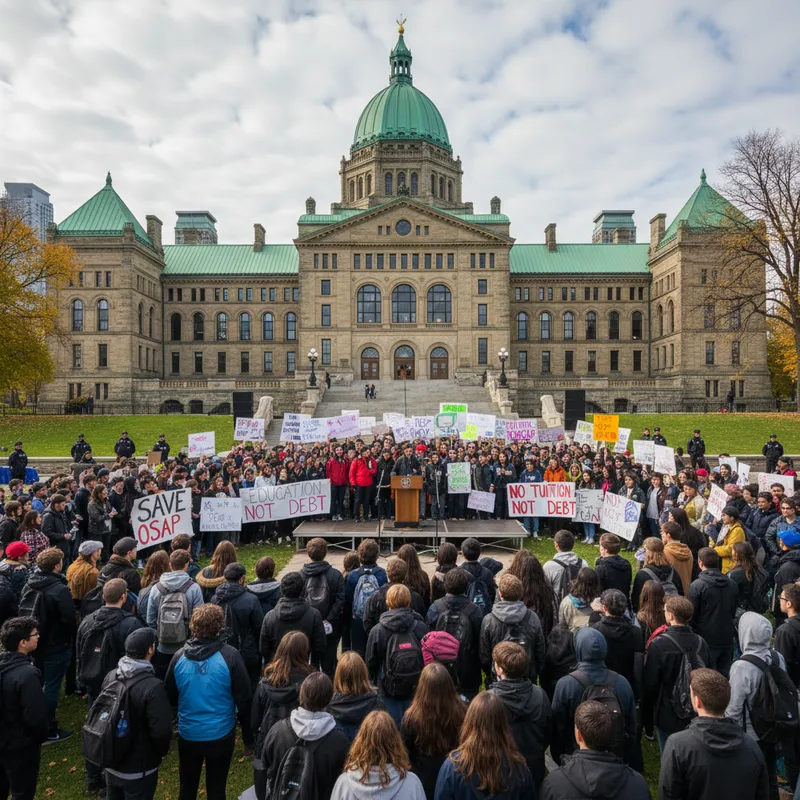
Hundreds of Ontario students gathered at Queen’s Park on Tuesday afternoon, their chants echoing across the legislative grounds as they protested the provincial government’s recent changes to post-secondary student funding. Carrying signs with slogans like "hands off our campuses," demonstrators voiced their anger over cuts to the Ontario Student Assistance Program (OSAP) and a decision to unfreeze tuition.
The protest, organized by the Canadian Federation of Students-Ontario, saw a significant police and security presence, with officers stationed at the legislature's entrance and along its fenced perimeter. Chants of, "Hey, hey, ho, ho, Doug Ford has got to go," were recited by the crowd, underscoring the deep frustration felt by many high school, college, and university students about the shifting financial landscape of higher education.
The demonstration follows a contentious announcement in February where the Ford government outlined a significant overhaul of OSAP. The changes are part of a broader fiscal strategy, as the government prepares its next budget amid concerns over deficits. The province plans to unfreeze tuition fees, allowing institutions to increase them, while also dramatically altering the structure of financial aid.
OSAP changes drive student anger
At the heart of the students' concerns is a major shift in how OSAP funding is allocated. Previously, students eligible for assistance could receive up to 85 per cent of their funding as non-repayable grants, with the remaining 15 per cent provided as a loan. Under the new framework, that ratio is flipped, with only 25 per cent of funding coming as grants and 75 per cent as loans that students will have to repay.
Critics argue this will saddle graduates with significantly more debt, potentially discouraging individuals from lower-income backgrounds from pursuing higher education. The government has defended the move, with Premier Doug Ford stating in February that the OSAP program needed an overhaul. He noted that without changes, program costs were projected to swell to $4.1 billion annually by the 2028-29 fiscal year.
Information on the current program structure and eligibility is available on the official Government of Ontario website. The changes have become a focal point for organizations critical of the government's spending priorities, such as the coalition behind the ItsOnFord.ca tracking dashboard.
Anyone who wants to protest, you come to Queen's Park, do cartwheels, jump up and down. Whatever you want to do .. Do not vandalize those statues.

Security tightened after previous clash
Tuesday’s rally followed an earlier, more volatile demonstration on March 4. That protest saw a clash between demonstrators and police that resulted in the arrest of two students. The Canadian Federation of Students-Ontario alleged at the time that protesters were “brutalized” by police officers.
During that earlier event, a statue of George Brown, a Father of Confederation and founder of The Globe newspaper, was defaced with spray-painted insults aimed at Premier Ford. The incident heightened tensions between protestors and law enforcement and set the stage for the enhanced security measures seen this week.
The political climate in Toronto has been particularly charged, with debates over protest and public conduct extending to the municipal level, where one Toronto councillor is facing council over controversial comments. The debate over the acceptable limits of public demonstration is also happening in other jurisdictions, reflected in an Oshawa council fight over event bans in a public park.
Officials defend precautionary measures
In anticipation of Tuesday’s protest, legislative staff took the unusual step of wrapping eight historical statues on the Queen's Park grounds in protective coverings. The move was a direct response to the vandalism earlier in the month.
Premier Ford addressed the issue at a press conference last week, drawing a firm line between peaceful assembly and property damage. “Anyone who wants to protest, you come to Queen's Park, do cartwheels, jump up and down. Whatever you want to do . Do not vandalize those statues,” Ford said. “They're historic, and if you do, you're going to get charged.”
Donna Skelly, the Speaker of the Legislative Assembly of Ontario, echoed the Premier's sentiment in a written statement. She called the wrapping of the statues a “preventative measure” and emphasized that safety and the protection of public property are a “top priority.”
Skelly stated that repairing vandalism forces the government to spend thousands of dollars of taxpayer money. The funds, she says, “should not have to be spent."