Ottawa’s new research money comes with a stopwatch.
University of Ottawa leaders say the federal government’s Budget 2025 is forcing universities to mobilize in months, not years, as Ottawa links research spending to economic and political sovereignty.
What canada’s budget 2025 means for university research
Kevin Page, founding president and CEO of the Institute of Fiscal Studies and Democracy at the University of Ottawa, told a campus audience the budget is built for a minority Parliament and a fraught global backdrop.
“The federal budget is a political document,” Page said. “It’s a vote of confidence. If Parliament disagrees, the government could fall.”
Page said the budget’s framing reflects “geopolitical instability, trade disruption and renewed concerns about national security and sovereignty.” He pointed to the title, Canada Strong, as a signal of the government’s focus.
“The Prime Minister is saying: we’re going to be singularly focused on economic growth and national defence, and I’m prepared to run higher deficits to do that,” Page noted.
Page warned that speed, scale and execution risks now shape federal expectations of the public service and its partners, including universities.
“The system is being pushed to create new agencies and programs while injecting roughly $30 billion into the economy. That’s not business as usual,” Page said.
How the $1.7B “research talent” funding is expected to work
Julie St-Pierre, University of Ottawa vice-president of research and innovation, said the budget’s most immediate effect for campuses is the pace of new funding tied to research talent.
“For research, in my timeline, I’ve never seen a budget like this,” St-Pierre said. “The $1.7 billion for research talent is truly unique, not just for its size, but for its speed. We need to seize this moment.”
St-Pierre said the funding targets senior investigators as well as early-career faculty, trainees and students. She said implementation is measured in months.
She also pointed to a change affecting lab and facility plans. The Canada Foundation for Innovation will cover 100 per cent of infrastructure costs tied to the new Canada Impact+ Research Chairs, removing the usual need for provincial matching funds.
“That’s a major enabler,” St-Pierre said.
Which fields ottawa is prioritizing for impact+ chairs
St-Pierre said the budget supports longer funding horizons than researchers often see, with up to eight years and potential four-year renewals for Impact+ chairs and aligned projects.
She listed focus areas that mirror federal priorities, including clean technology, security, defence, climate resilience, Arctic research, quantum science, AI and health care. She said uOttawa is already active in those fields.
St-Pierre also flagged money aimed at building intellectual property and keeping it in Canada. She said it addresses a national gap where discoveries are made here, but economic value often leaves.
Readers can track the government’s fiscal plan in the federal budget documents, which set out the programs and timelines referenced by universities and research agencies.
Will international recruitment crowd out researchers already in canada?
A question from the floor at the University of Ottawa event pressed on a concern heard across the sector. A faculty member asked whether international recruitment could sideline researchers already working in Canada, especially after recent reductions to core research funding.
St-Pierre said the Impact+ program is built to support the “full research pipeline,” from students to senior investigators. She said recruited researchers come with long-term operating funding, up to 12 years, which supports trainees and programs rather than drawing from existing envelopes.
She said the goal is expansion, not substitution. She also said the design aims to attract Canadians working abroad who want to return.
Page framed the issue as one of national competitiveness. He said Canada still underinvests in research and development compared with peer countries.
“This budget is a step forward,” Page said, “but it’s incremental. It sets a foundation, but it doesn’t finish the job.”
The system is being pushed to create new agencies and programs while injecting roughly $30 billion into the economy. That’s not business as usual.
When researchers need to apply, and what happens next
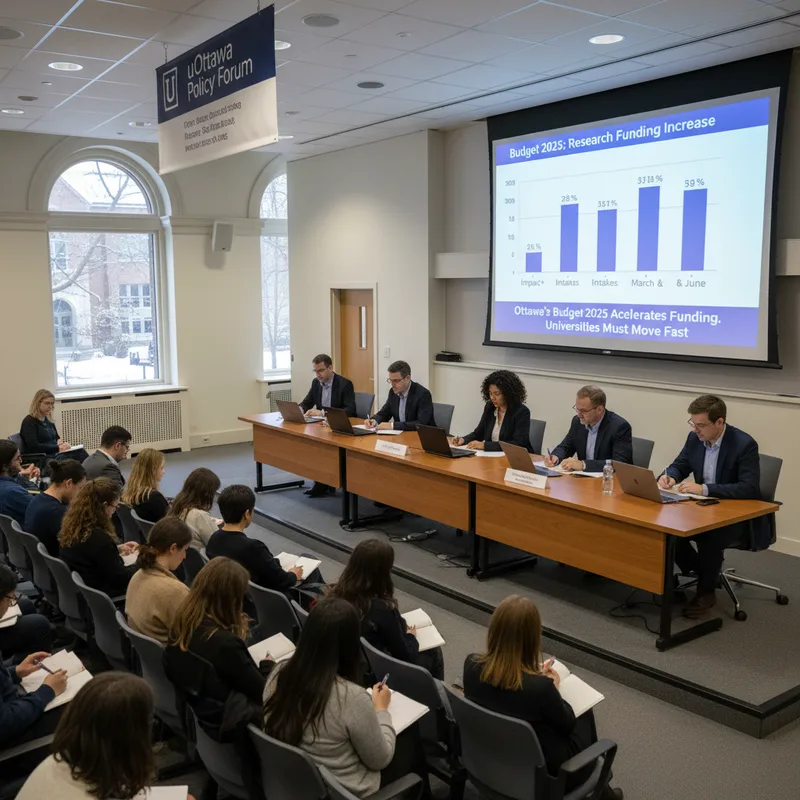
St-Pierre said readiness is the pressure point, because the intakes begin almost immediately. “Universities need to mobilize quickly,” she said. “The first intake for Impact+ starts in March, followed by a second one in June.”
That timeline forces fast internal decisions on team composition, partner commitments, and how universities plan for hiring and space. It also raises the stakes for coordination with government and industry.
In Ontario, universities already face competing pressures on staffing, student support, and programming. Recent campus political activity, including OSAP grant cut protests, has kept attention on affordability alongside research ambitions.
For Ottawa-based researchers, the next key dates are the March and June intakes St-Pierre cited, as institutions rush to assemble proposals before those deadlines.