
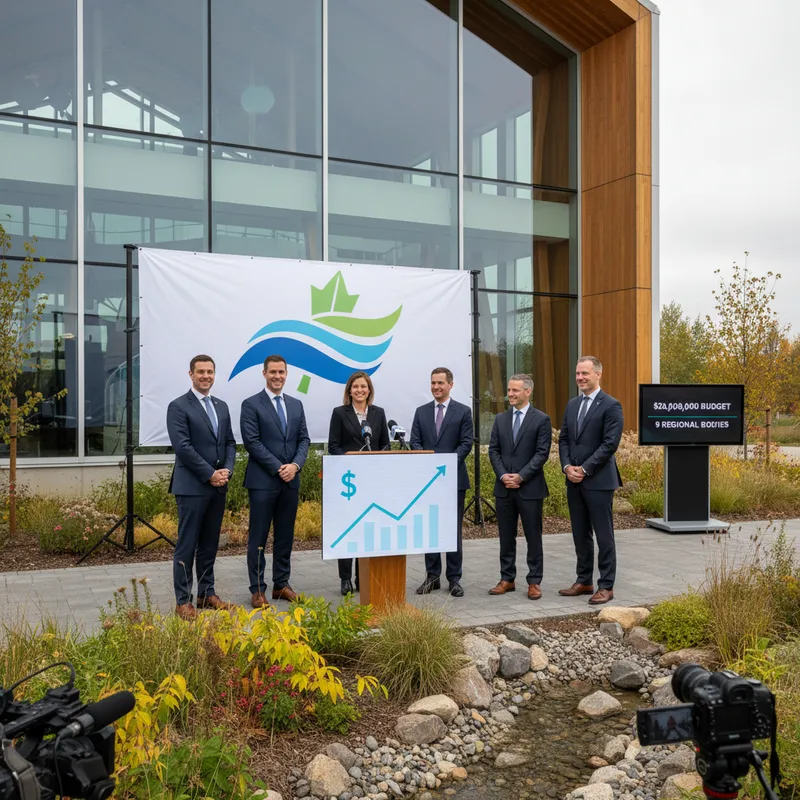
The Ford government is moving ahead with a plan to consolidate Ontario's 36 conservation authorities into just nine regional bodies. To manage the transition, the province has established a new agency backed by a $20 million budget. This overhaul marks a significant shift in how the province manages its watersheds and natural hazards. Environment Minister Todd McCarthy announced the details on Tuesday, stating the current system is too fragmented. He argued that varying standards and fees across the 36 existing authorities have created a "predictable and inconsistent" environment for homeowners and builders. According to McCarthy, these inconsistencies have led to delays in permit approvals and uncertainty for the agricultural sector. The ministry claims it consulted with more than 500 people before finalising the plan. A proposal posted to the Environmental Registry of Ontario also drew more than 14,000 public comments. However, the government's path to this decision has faced criticism from those who rely on the specific technical expertise of local watershed managers.
Impact on simcoe and lake huron regions
Under the new provincial mapping, the Simcoe County area will be absorbed into a large entity called the Lake Huron Regional Conservation Authority. This new district will encompass the current territories of the Lake Simcoe Region Conservation Authority (LSRCA) and the Nottawasaga Valley Conservation Authority (NVCA). The LSRCA currently manages a catchment area that includes Barrie, Innisfil, and nature programs stretching into York and Durham regions. The NVCA covers a broad sweep of territory from Collingwood to Wasaga Beach. These separate entities will now be merged into a single administrative body. This consolidation comes as the province faces mounting pressure over land use and environmental protection. Other agencies, such as the TRCA, have historically managed huge swaths of the GTA and surrounding regions under similar mandates. The government believes a streamlined approach will accelerate housing development.
Critics fear loss of local expertise
For nearly eight decades, conservation authorities have served as the frontline for protecting drinking water and managing flood risks. They use hydrologic studies and flood maps to determine where it is safe to build. Many municipalities fund these authorities directly to ensure local development does not lead to erosion or property damage. Paola Cetares, director of public affairs for the Ontario Society of Professional Engineers, told The Narwhal that these bodies do more than just issue permits. She said they provide the technical rules that make projects workable while protecting people and water. There are concerns that larger, regionalised boards may lose the granular knowledge required to manage specific local creek systems or sub-watersheds. The shift mirror changes seen in other jurisdictions where centralisation is used to cut red tape. Similar moves to consolidate roles have been documented elsewhere, such as when the NSW Government opened hundreds of new roles to centralise trainee management. In Ontario, the $20 million transition budget is intended to smooth the administrative handovers between the old and new boards.
A history of regulatory shifts
The provincial government has a history of tense relations with conservation authorities. Previous legislative changes had already narrowed their scope, limiting their ability to comment on development applications to strictly hazard-related issues like flooding. This latest move to reduce the total number of authorities is the most dramatic structural change in the system's history. Public interest in these changes has been high. Recent years have seen increased activism regarding provincial environmental policy, including instances where Ontario students and community groups have protested broad administrative cuts. The scale of the 14,000 comments on the Environmental Registry reflects the level of local concern. The new regional bodies will be expected to produce uniform standards for stormwater management and hydrologic studies. McCarthy insists this will bring "certainty" to the building process. He says the current patchwork of 36 different sets of rules is no longer sustainable for a growing province. The $20 million agency will now begin the process of redrawing boundaries and merging staff from the affected districts. Municipalities will have to wait to see how their funding contributions will be recalculated under the nine-district model. The government has not yet released a firm date for when the existing 36 authorities will officially cease independent operations.